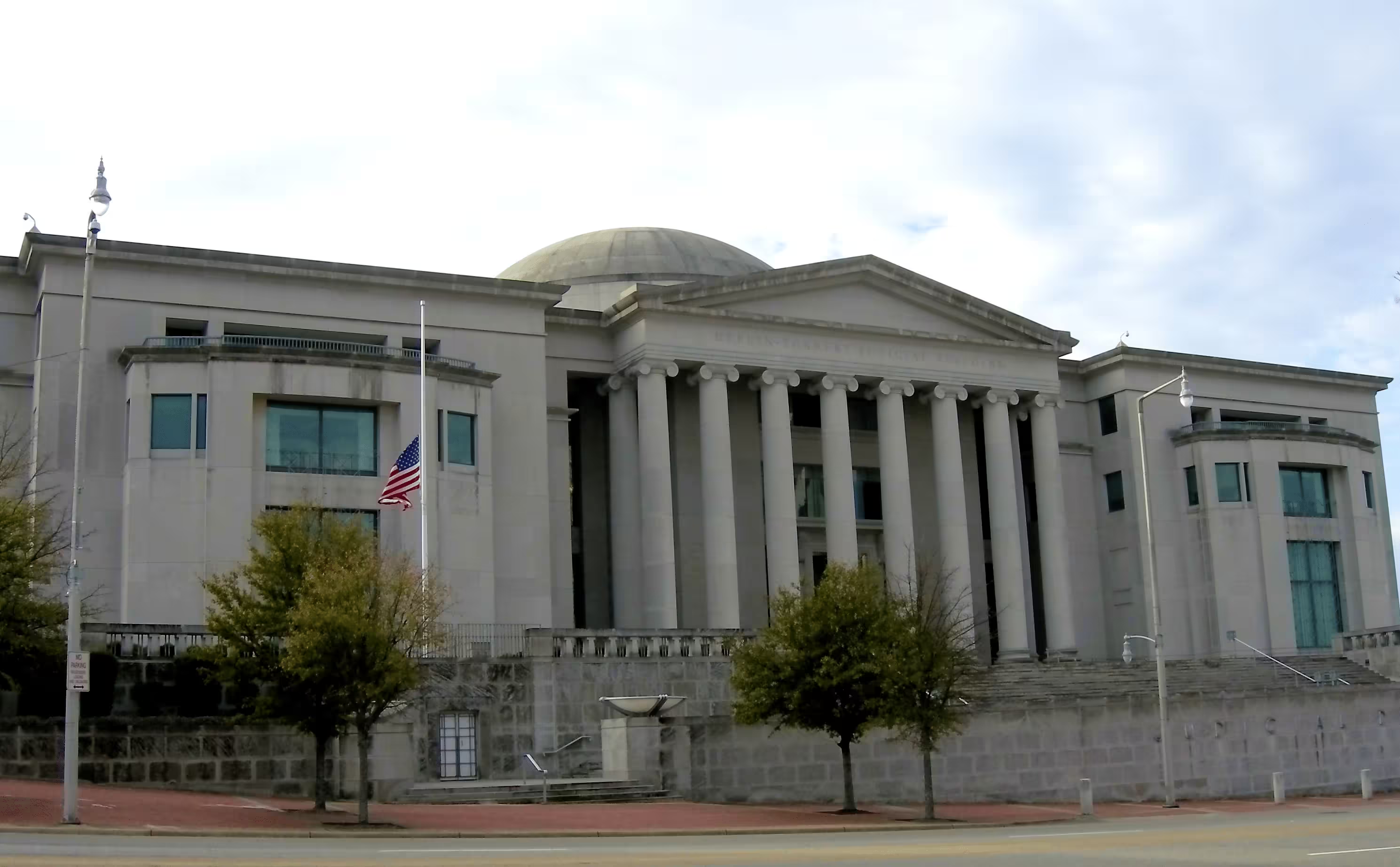
In the case George v. State (2021), Manfred Schenk, an expert in radio frequency (RF) and cellular technology from Cherry Biometrics, challenged the admissibility of cell-site location data (CSLD) testimony. His expertise influenced the Alabama Supreme Court’s decision to reclassify such testimony as scientific, triggering a Daubert analysis and ultimately leading to the reversal of the defendants’ convictions.
Schenk’s testimony challenged the prosecution’s claim that Allison Duncan, an intelligence analyst, could present CSLD analysis as “lay” testimony. He emphasized the complex scientific principles underlying cellular networks, explaining that while signal strength correlates with proximity to cell towers, exact location determination is not straightforward. His assertion that “there’s a correlation between signal strength and distance, but an actual distance we do not know” highlighted the inherent uncertainties and technical nuances in CSLD analysis.
Setting a precedent for scientific scrutiny
When asked whether projecting a cellphone’s location relies on scientific theory, Schenk unequivocally affirmed it does. This testimony underscored that tools like Penlink (software used by Duncan) depend on RF propagation models, antenna patterns, and network topology—all rooted in engineering and physics. By framing CSLD analysis as inherently scientific, Schenk forced the court to confront the inadequacy of treating it as mere “technical” or experiential knowledge.
The Alabama Supreme Court cited Schenk’s testimony to reject the lower court’s classification of Duncan’s work as lay testimony. The justices noted that CSLD analysis requires specialized scientific methodologies, such as triangulation and signal attenuation modeling, which demand validation under Daubert. Schenk’s insights were instrumental in showing that Duncan’s conclusions relied on unverified scientific assumptions, not just training or experience.
- The court ruled CSLD testimony must be treated as scientific expert testimony, subject to reliability checks under Alabama Rule 702(b).
- The convictions were vacated, and the case was sent back to the trial court to assess whether Duncan’s methodology met scientific standards—a direct result of Schenk’s intervention.
- The decision sets a benchmark for CSLD admissibility, emphasizing that even tools marketed as “user-friendly” (e.g., Penlink) cannot bypass scientific scrutiny.
The winning attorney was Richard M. Kemmer, Jr., P.C.
Reach out to our experts
If your case involves cell towers, CDRs (Call Detail Records), CSLD (Cell Site Location Data), or related technologies, contact us. Understanding the nuances of cell tower data is critical. Incorrectly handled evidence can lead to flawed conclusions. Our experts, like Manfred Schenk of Cherry Biometrics, can help ensure that your case is evaluated with the scientific rigor it deserves.
Cherry Biometrics Inc.
18766 John J Williams Hwy #228
Rehoboth Beach, DE 19971
(201) 513-8300
mcherrycp@gmail.com